
A pocket camera slider is a short, compact track that moves a small camera, such as a DJI Osmo Pocket or Insta360 Luna, smoothly from one point to another while it records. The motion adds depth and a “cinematic” feel to B-roll, product shots, and timelapses that a static tripod can’t give you. If you film products, food, desk setups, or travel scenes with a pocket camera, a slider is one of the simplest ways to make your footage look more professional.
How a camera slider works
A slider holds the camera on a carriage that travels along a rail. As the camera moves, objects at different distances shift at different speeds (parallax), which is what makes the shot feel three-dimensional.
There are two types:
| Type | How it moves | Best for | Trade-off |
|---|---|---|---|
| Manual slider | You push the carriage by hand | Occasional use, tight budget | Hard to keep speed perfectly even |
| Motorized slider | A motor moves the carriage at a set speed | Repeatable moves, timelapses, solo creators | Needs charging; costs more |
Most sliders on the market are built for DSLRs and mirrorless cameras, so they are long and heavy. Pocket cameras are small enough that a much shorter, lighter slider does the job.
Why pocket cameras benefit from a slider
Pocket cameras like the Osmo Pocket series already have a built-in gimbal, so footage is stable. What a gimbal can’t do on its own is move the camera through space at a perfectly even speed. A slider adds that:
- Push-in and pull-out shots toward a subject
- Side-to-side reveals across a desk, plate, or product
- Motion timelapses, where the camera creeps slowly across a scene over minutes or hours
- Repeatable takes, so you can re-shoot the same move until the subject is perfect
What to look for in a pocket camera slider
- Compatibility. Check that the mount fits your camera (for example Osmo Pocket 3 or 4, or Insta360 Luna).
- Travel length. Around 30 cm (about 12 inches) is enough for most tabletop and close-up shots while staying portable.
- Speed control. Several speed settings let you match slow, dramatic moves or quicker transitions.
- Modes. Auto back-and-forth and timelapse modes save you from re-triggering every take.
- Remote control. A wireless remote lets you start a move without touching (and shaking) the setup.
- Noise. A quiet motor matters if you record audio on the camera.
- Portability. If you travel, look for something that folds small and doubles as a monopod or selfie stick.
An example: the KONOVA DS3
Disclosure: the author of PocketCam Daily is affiliated with KONOVA, the maker of the DS3.
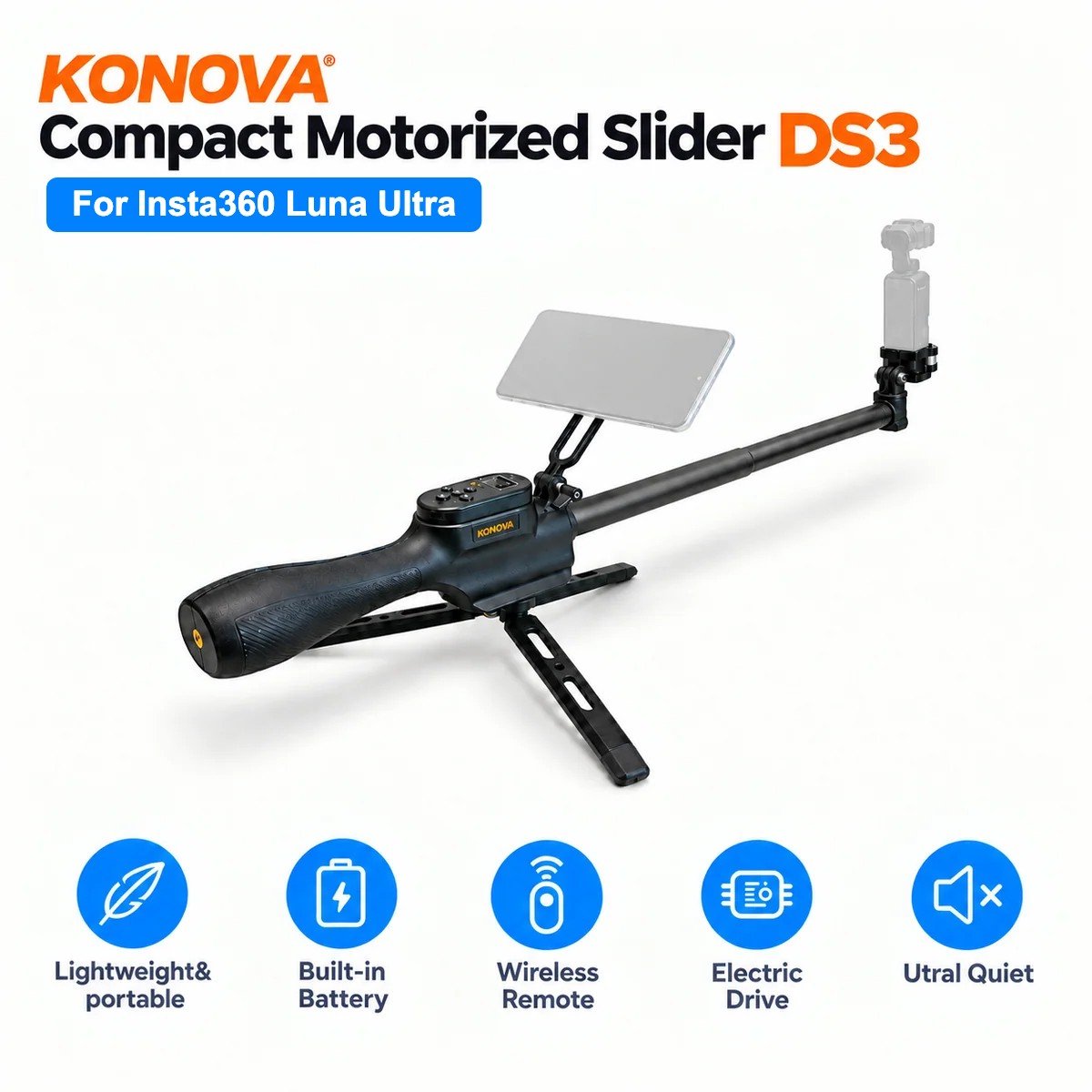
The KONOVA DS3 is a compact motorized slider designed for pocket cameras:
- Works with DJI Osmo Pocket 3, 4 and 4P, and Insta360 Luna & Luna Ultra (plus action cameras and phones)
- 3-in-1: motorized slider, monopod, and selfie stick
- 30 cm / 11.8 in of motorized travel
- 5 speed settings with quiet operation
- Manual, auto (back-and-forth), and timelapse modes
- Wireless remote that stores magnetically on the slider
- Built-in battery; folds to about 47 cm and weighs about 1.26 lb
Do you need one?
You’ll get the most from a pocket camera slider if you:
- Shoot product videos, unboxings, food, or desk setups
- Want timelapses with camera movement
- Film alone and need repeatable moves
You can probably skip it if you:
- Mostly film handheld vlogs while walking
- Only shoot wide landscapes where camera motion is barely visible
FAQ
Can I use a regular camera slider with an Osmo Pocket?
Yes, with the right mount, but most regular sliders are built for heavier cameras and are larger than you need. A pocket-sized slider is easier to carry and set up.
Is a motorized slider better than a manual one?
For smooth, even speed and timelapses, yes. Manual sliders are cheaper but it’s hard to move them at a perfectly constant speed by hand.
How long should a slider be for a pocket camera?
Around 30 cm (12 in) covers most tabletop and close-up shots. Longer rails help with wide scenes but are harder to travel with.
Does a slider replace a gimbal?
No. The gimbal keeps the camera level and stable; the slider moves it through space. They work together.